
How it works
From the word you didn't catch to the sentence that sticks.
Look up the word you didn't get, save sentences that use it, and the app brings each sentence back at the right time, in speaking, seeing and listening drills. This page explains the method. For the hands-on guide, see Get started.
In one paragraph
What is dailyBe?
dailyBe is an English vocabulary app for people who are past the basics. It brings three things together: an AI dictionary where you look up the words you ran into and didn't understand; a list of sentences that's entirely yours; and a review system that brings each sentence back just before you'd forget it.
Think of it as the discipline of flashcards, without building decks or schedules yourself. And what you study doesn't come from a one-size-fits-all list: it comes from the shows, meetings and articles you only half understood.
If you can say I'm busy. but wouldn't catch I'm swamped with meetings., you don't need more of the same. You need what's missing.
- What you say: I'm busy.What you hear on TV: I'm swamped with meetings.Estou atolado de reuniões.
- What you say: We had to cancel.What you hear on TV: We had to call it off.Tivemos que cancelar.
- What you say: I forgot.What you hear on TV: It completely slipped my mind.Me fugiu completamente da cabeça.
- What you say: I don't know yet.What you hear on TV: I'm still on the fence.Ainda estou em dúvida.
The problem
Why did your English stop improving?
Because the words you're missing rarely show up in what you watch and read. Context covers the gaps: you follow the plot, laugh at the right moments and move on without knowing exactly what was said.
- unknown words in speech, even when you know 95% of them
- ~7 a minute
- Paul Nation (2006), at 150 words per minute
- word families: the mid-frequency band, where the missing words live
- 3,000 to 9,000
- Norbert and Diane Schmitt (2014)
- of the Shrek script comes from the sixth 1,000-word band, and most of those words appear only once
- 0.33%
- Paul Nation (2006)
That's why one more episode, one more generic class or one more week on a beginner app mostly reinforces what you already know. Beginner apps work well early on; after that, points and streaks on their own give you a sense of progress that doesn't touch what's missing. The full numbers are in our post The words your English is missing.
The method in 3 steps
How does a strange word become part of your vocabulary?
Through three steps that keep repeating: discovery, practice and retention. In each one, there's a part that's on you and a part the app handles.
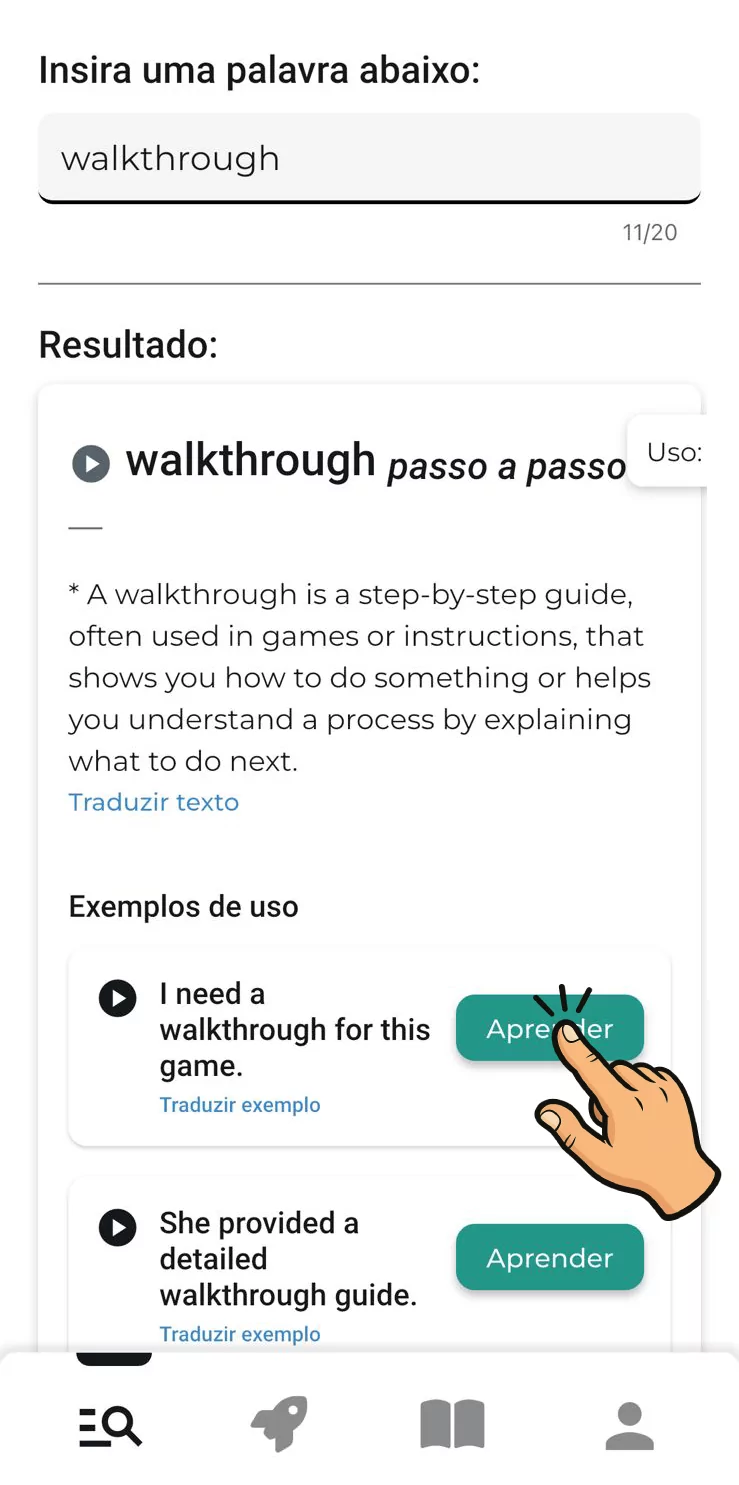
Looking up walkthrough: meaning, example sentences and the Learn button. Discovery
Add new words to your vocabulary, in context.
- You
- Look up the word that tripped you up: the one from last night's episode, from your boss's email, from the song you sing along to without knowing what it means.
- The app
- Shows the meaning and at least five AI-generated example sentences, with audio. Single words, expressions and phrasal verbs like call it off all work.
- You get
- Sentences in context on your list, picked by you with a tap on Learn (Aprender in the app). Since the same word shows up in several sentences, you review it in different contexts.
Other ways in
- Quick diagnostic. The first time you open the app, a short diagnostic asks what you want English for (travel, work, general…) and uses your answer to steer your first words and study.
- Stories. Short stories, 30 sentences each, to build your vocabulary. Good if you're closer to the beginning and don't have many words jotted down to look up yet.
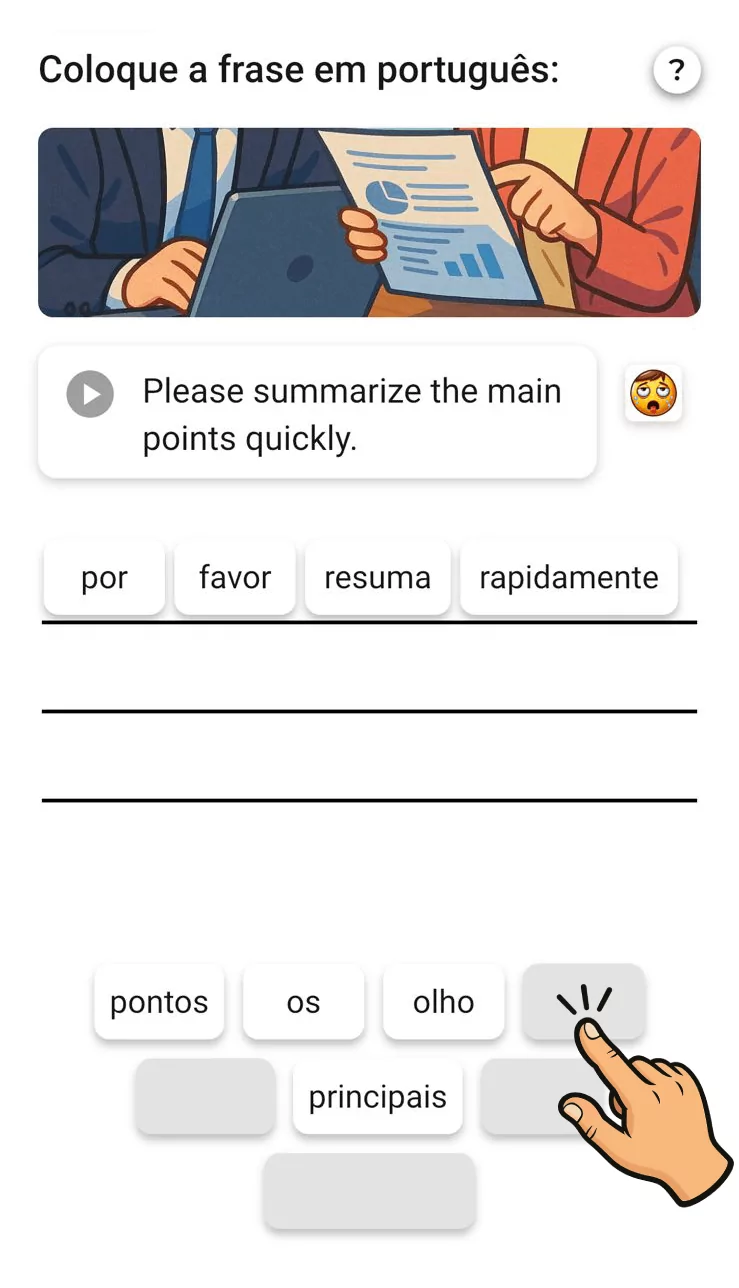
One of the drills: put the sentence you read and heard into Portuguese. Practice
Practice the sentences you added in different modes.
- You
- Drill each sentence by speaking, seeing and listening, in 10-sentence sessions with your full attention.
- The app
- Switches between modes so you pull the same sentence out of memory by different routes: through the text, the sound and your own voice.
- You get
- Catching the sentence when someone says it fast, not just when it's written in front of you.
The three practice modes
- Speaking. You say the sentence out loud. The app uses speech recognition, shows what it heard and, if it doesn't match, gives you a pronunciation tip spelled the way a Brazilian would read it in Portuguese.
- Seeing. You start from the written sentence and pull its meaning from memory.
- Listening. You start from the sound of the sentence and train your ear to catch it when it's spoken.
A sample pronunciation tip I should have known better.
ai xúdav nôun bérer
Eu devia ter imaginado.
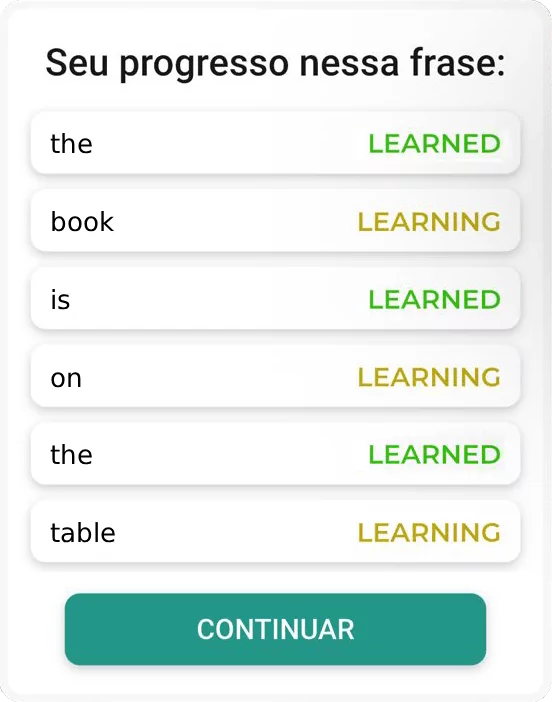
Progress on one sentence, word by word. Retention
Review your sentences at the right time to build long-term memory.
- You
- Open the app at your usual time and review the sentences it brought back, trying to recall each one before you see the answer.
- The app
- Decides when each sentence comes back: get it right and it returns later; miss it and it returns sooner. It also scores every word: your correct answers divided by the number of times the word came up. Past a certain percentage, the word counts as learned and drops out of focus; once every word in a sentence is learned, the sentence leaves active practice and the next ones move up.
- You get
- Time spent on what you don't know yet, not on what you've already got down. Every sentence you practice adds to your overall vocabulary.
Spaced repetition
What is spaced repetition, in plain English?
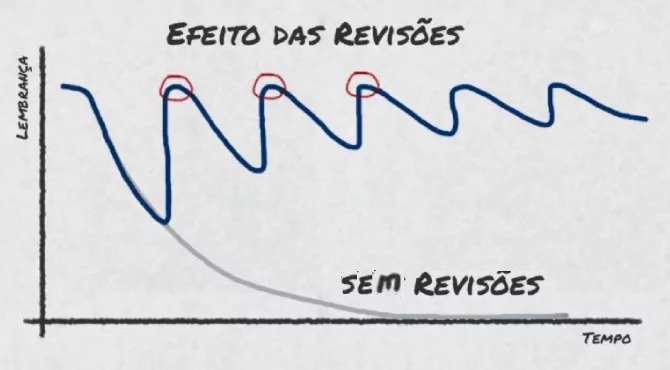
It means reviewing each sentence at growing intervals, trying to recall it before you see the answer. Right after you learn something, you forget it fast; every successful review makes the memory last longer, so the next review can wait longer.
The idea is old and well tested. In 1885, Hermann Ebbinghaus found that 38 repetitions spread over three days worked as well as 68 crammed into one. In 2022, a meta-analysis by Su Kyung Kim and Stuart Webb pooled 48 experiments with 3,411 second-language learners and found a medium-to-large spacing effect.
It has limits, too: reviewing keeps you from forgetting, but understanding without thinking also takes meeting the words in real English. dailyBe handles the reviews. Shows, conversations and reading are still where the words come from.
How the app decides when a sentence comes back
Picture a ladder of intervals, in days. Every sentence starts on the bottom rung. Get it right and it climbs one rung and takes longer to come back; miss it and it drops one and comes back sooner.
There's no daily cap on reviews: whatever comes back, you review.
- 1day
- 1day
- 3days
- 5days
- 7days
- 14days
- 28days
- 54days
One sentence, right every time
I've been meaning to call you. Faz tempo que eu quero te ligar.
- TodayPracticed it, got it rightback tomorrow
- Day 1Got it rightback in 3 days
- Day 4Got it rightback in 5 days
- Day 9Got it rightback in 7 days
- Day 16Got it rightback in 14 days
- Day 30Got it rightback in 28 days
- Day 58Got it rightback in 54 days
What if you miss it? Say you blank on it on day 9. The sentence drops one rung and comes back in 3 days (day 12) instead of 7. Get it right on day 12? It climbs again and comes back in 5. The first two rungs are both 1 day: early on, a sentence keeps coming back the next day until you get it right two days in a row.
The session
Why isn't dailyBe a five-minutes-a-day app?
A session can take five minutes; your study day shouldn't. Memory depends on attention at the moment information goes in, and that's exactly what scattered breaks lack. So we count by the day: 20 to 30 focused minutes, over a few sessions.
- 10 sentences
- in each session, practiced by speaking, seeing and listening
- 4 to 25 min
- per session in the tests we watched: from people with more English to people just past the start
- No cap
- on sessions: as long as there are sentences to study, you can start another
- Your goal
- for the day, set by you (10, 15 minutes or more), with a streak and stars
In 1996, Fergus Craik and colleagues had volunteers memorize word lists while doing a second task: splitting attention while learning caused large memory losses. In 2006, Henry Roediger and Jeffrey Karpicke showed that people who practiced recalling a text remembered 61% of its ideas a week later; people who just reread it, 40%.
Trying to recall takes more effort than rereading. That's why it works, and that's why it doesn't fit between two meetings.
Only want five minutes a day? Beginner apps do that well. dailyBe is for people who want to understand every sentence and are willing to study for it.
Moments that work
- Your bus, subway or train ride
- A time slot blocked on your calendar
- Right after a fixed habit, like breakfast
Moments that don't
- The gap between two meetings
- The checkout line
- The TV on in the background
An honest comparison
How does dailyBe compare to a course, flashcards and beginner apps?
Each one is best at something. dailyBe is best at one thing: filling in the missing words for people who are past the basics.
| Criterion | dailyBe | Traditional course | DIY flashcards | Beginner app |
|---|---|---|---|---|
| Best for | Filling the gaps once you understand most of it | Structure, grammar and speaking practice | People who know what to study and like building their own material | Starting from zero and building the habit |
| Where your material comes from | The words you ran into and looked up | The course syllabus | You: every card is written by hand | The same path for everyone |
| Ready-made example sentences for each word | Yes | Whatever the book has | No | Whatever the path has |
| Spaced-repetition reviews | Yes | Depends on the teacher | In most programs | Varies from app to app |
| Conversation with a real person | No | Yes | No | No |
| Typical session | 10-sentence sessions; 20 to 30 focused minutes a day | Scheduled classes | Up to you | A few minutes a day |
Taking classes? Keep going. dailyBe works as a complement: the class gives you structure, and your list covers the vocabulary that's yours alone.
Fit
Is dailyBe right for you?
It's for you if…
- You understand 60% to 70% of what you read, hear and watch in English and want to get the rest.
- You feel you already know enough, but you keep missing the tone, the joke and the detail.
- You want to study what shows up in your life, not a list that's the same for everyone.
- You're willing to set aside 20 to 30 focused minutes at a fixed time of day.
- You take classes and want a vocabulary-only complement.
It's not for you if…
- You're starting from scratch: without a base, almost everything is a gap.
- You want five minutes between meetings.
- You're looking for conversation practice with a teacher.
- You expect fluency in a few days. There's no shortcut here.
Questions
Questions about the method
Is dailyBe a flashcard app?
Partly. As with flashcards, you review sentences by trying to recall them, and each one comes back through spaced repetition. The difference is where the sentences come from (the AI dictionary, based on the words you looked up) and how you practice: in three modes, speaking, seeing and listening.
Where do the example sentences come from?
They're generated by AI. Every word you look up shows at least five sentences, and you choose which ones go on your list. If you spot a pronunciation or translation error in a sentence, you can report it in the app and the sentence goes to human review.
When does a sentence come back for review?
It depends on how you did. The app's intervals are 1, 1, 3, 5, 7, 14, 28 and 54 days, like the rungs of a ladder. Get a sentence right and it climbs a rung and comes back later; miss it and it drops a rung and comes back sooner. If you get it right every time, a sentence you practice today comes back tomorrow, then in 3, 5, 7, 14, 28 and 54 days.
Why study whole sentences instead of single words?
Because a sentence shows which words an expression usually goes with, the tone it's used in and how it sounds in speech. Knowing that swamped means overloaded is one thing; catching I'm swamped this week when someone says it fast is another.
How does the app know when a sentence is learned?
It scores every word, not just the sentence: your correct answers divided by the number of times the word came up. Past a certain percentage, the word counts as learned and stops being a focus. Once every word in a sentence is learned, the sentence leaves active practice and the next ones on your list move up.
iOS and Android
Start with the word you didn't understand today.
Download dailyBe, look up that word and add your first sentences. The rest of the method starts there.