
Skip to content

For Brazilians living in the US

You speak English. You're just missing the everyday words.

Health insurance, your lease, notes from your kid's school, shift swaps. The vocabulary of everyday American systems isn't in any course. dailyBe helps you collect those words one at a time and review them until they stick.

For learners past the basics · iPhone and Android · 10-sentence sessions, as many as you like

Calling the doctor's office

Four sentences, three words no course taught you

  1. YouI'd like to make an appointment. I'm a new patient.Booking your first visit.
  2. YouDo you take my insurance?insurance: your health plan
  3. YouIs Dr. Lopez in-network?in-network: has a contract with your plan
  4. Front deskYour copay today is twenty-five dollars.copay: the fixed amount you pay for the visit
Examples from our everyday US vocabulary guide.

Where courses stop

Six situations where classroom English falls short

Each one runs on its own system, with words that often have no direct equivalent back in Brazil. And on the phone there are no subtitles, no picture and no rewind.

  • At work

    Shifts, pay and time off. The routine barely changes from one job to the next.

    shift
    the block of hours you're scheduled to work
    clock in / clock out
    log the start and end of your shift
    PTO
    paid time off
    call in sick
    tell work you're sick and not coming in

    You'll hear

    Can you cover my shift on Saturday?

  • Doctor and pharmacy

    Health insurance vocabulary is the most confusing part, because the system works nothing like Brazil's.

    premium
    what you pay every month for your plan
    deductible
    what you pay for covered care before your plan starts paying
    urgent care
    quick care for things that aren't an emergency
    refill
    another round of a prescription you take regularly

    You'll hear

    I'm here to pick up a prescription.

  • Your kids' school

    Notices, meetings and drop-off routines, usually in writing and with a deadline.

    third grade
    what Brazil calls terceiro ano
    parent-teacher conference
    a one-on-one meeting with your kid's teacher
    permission slip
    a form parents sign, usually for field trips
    drop-off / pick-up
    when you leave and collect your kid

    You'll hear

    Please sign and return the permission slip by Friday.

  • Rent and bills

    Lease and maintenance vocabulary, which you need from the very first apartment viewing.

    lease
    your rental contract
    security deposit
    money held in case of damage or unpaid rent
    utilities
    power, gas and water bills
    late fee
    the charge for paying rent late

    You'll hear

    Are utilities included in the rent?

  • Forms and lines

    Paperwork and front-desk words that repeat at almost every office you'll visit.

    fill out a form
    complete a form
    print your name
    write it in block letters (not print it out)
    proof of address
    a document that shows where you live
    take a number
    grab a ticket and wait to be called

    You'll hear

    Take a number and have a seat. We'll call you.

  • Small talk

    Short phrases everyone uses and nobody explains. Some of them aren't really questions.

    How's it going?
    a greeting, not a request for details
    What do you do?
    they're asking about your job
    For here or to go?
    eating in or taking it with you
    Have a good one!
    a goodbye that works at any time of day

    You'll hear

    What are you up to this weekend?

Why more of the same doesn't help

More of the same won't close the gap. The missing words will.

Courses teach the language in general. You learned I would like to make an appointment; nobody taught you what a copay, a lease or a permission slip is.

Watching more shows doesn't close that gap either. A new word goes by once, you guess it from context, and it's gone before it comes back. Meanwhile you keep “sort of” understanding, and the phone call, the meeting and the school notice keep asking for what's missing.

What works is studying the words your routine keeps throwing at you: the ones you heard and only half understood, one at a time, until they come out without thinking.

of the words spoken in Shrek come from the 1,000 most frequent word families in English
81%
come from the sixth thousand, and most of those appear only once
0.33%

Paul Nation's analysis (2006), discussed in our article on the words your English is missing.

What you already say, and what you'll hear

None of these are hard words. They're what a coworker, a manager or a neighbor says on any given Tuesday.

  • What you already know: busyWhat you hear here: We were slammed at lunch today.Slammed: so busy you could barely keep up. Common in restaurants, retail and customer service.
  • What you already know: a lot of workWhat you hear here: I have a lot on my plate right now.A polite way to turn down more work.
  • What you already know: answer laterWhat you hear here: I'll get back to you by Friday.Works in any professional setting.
  • What you already know: I'm leavingWhat you hear here: I'm heading out. See you tomorrow.Sounds more natural than I'm leaving now, which can come across as abrupt.
  • What you already know: no problemWhat you hear here: Don't worry about it.The safe choice in American English.

How dailyBe helps

From the sentence you heard to the sentence you use

  1. Look up the word that tripped you up

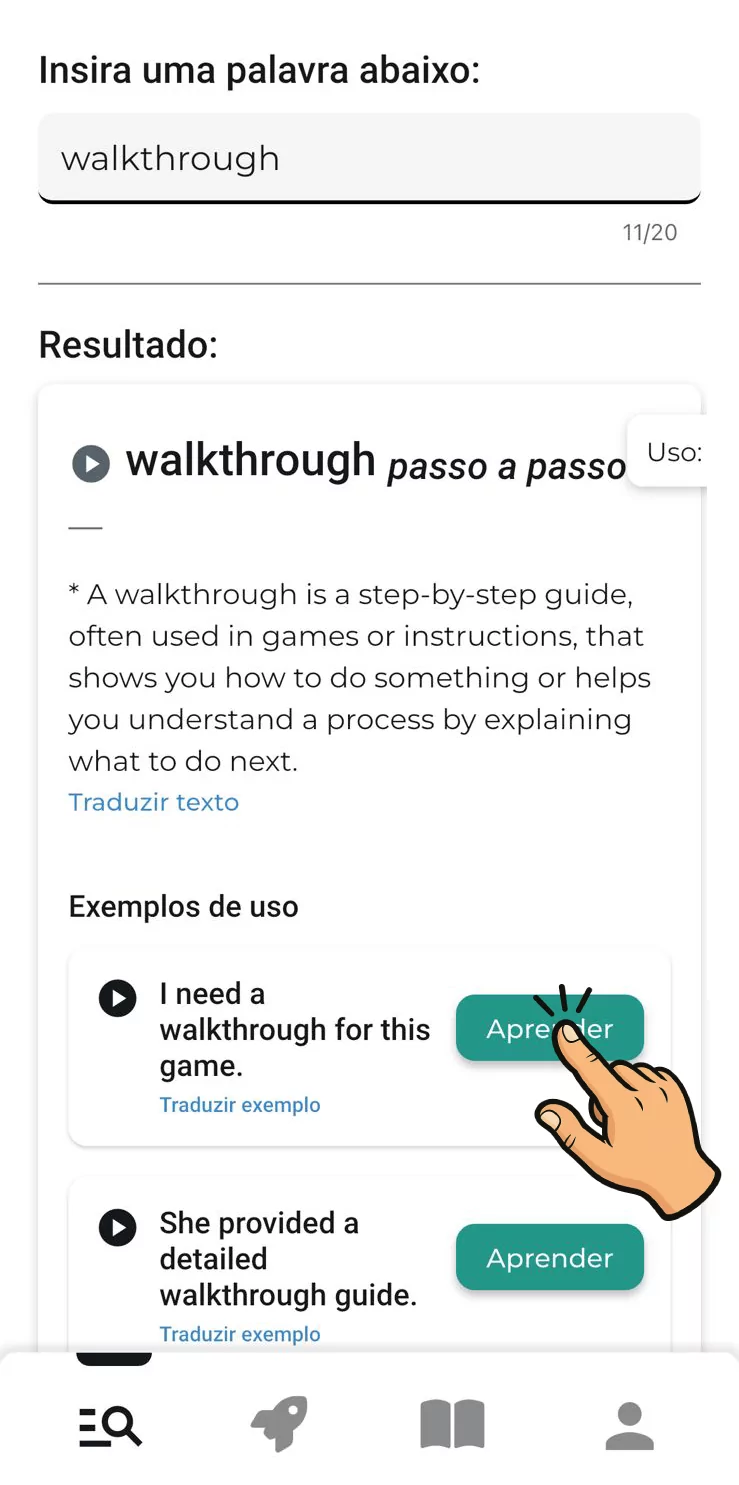
    The AI dictionary takes words and expressions from any area: copay, lease, cover a shift. You get the meaning and at least five example sentences with audio.

  2. Keep the sentences that fit your life

    Add the ones you'll need at your next appointment, meeting or phone call. Nothing goes on your list unless you pick it.

  3. Practice in 10-sentence sessions

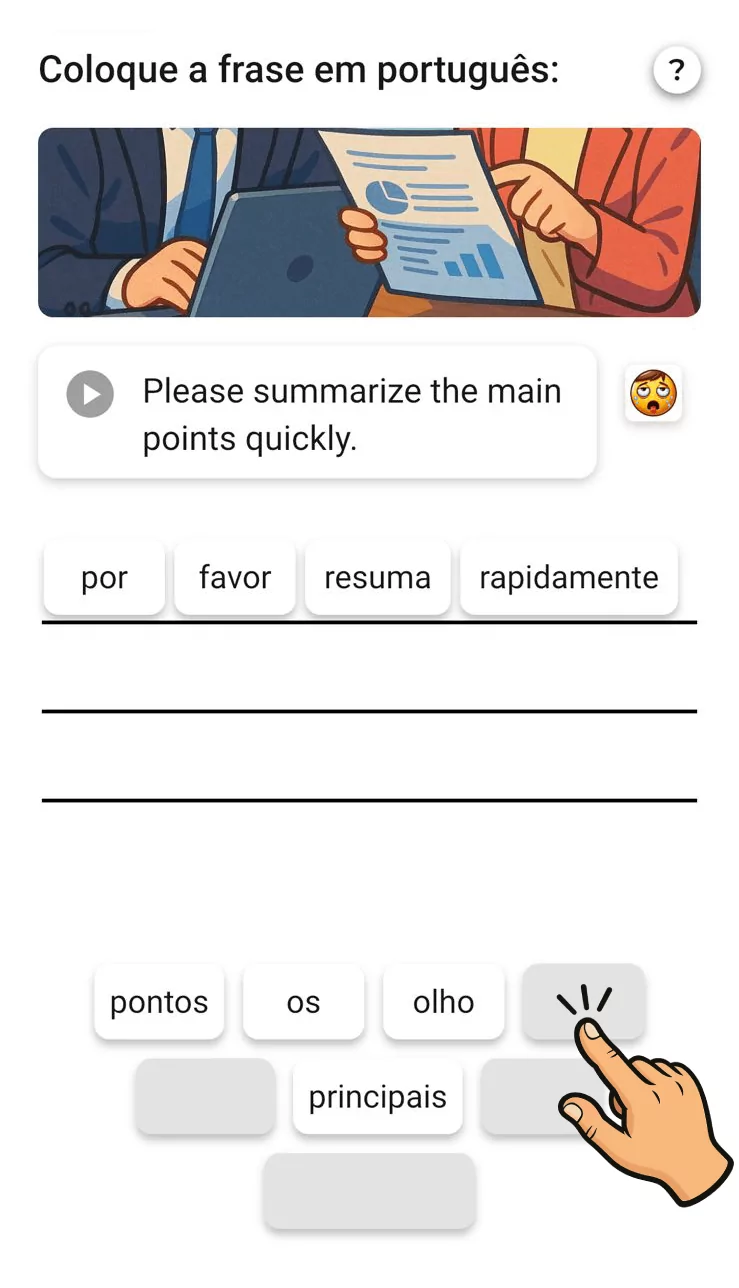
    Speaking, seeing and listening. In speaking mode, the app uses speech recognition and gives you a pronunciation tip when something doesn't match. Get it right and the sentence comes back later; get it wrong and it comes back sooner. And the app tracks your learning word by word, so you can see what has stuck.

The app's dictionary showing the word walkthrough, its definition and example sentences, each with a Learn button
An app exercise: rebuilding the sentence Please summarize the main points quickly in Portuguese

If you work long hours

It's not a five-minute app. It's half an hour of your focus.

Each session has 10 sentences, and you can do as many as you like. Stack a few until you reach 20 to 30 minutes a day, at a time when you can actually concentrate. A few distracted minutes in line at the store do a lot less than they seem to.

  1. During the day

    Write down the whole sentence

    Exactly as you heard it, right after the call, the conversation at work or the note from school. The notes app on your phone is enough.

  2. Same time, every day

    A few sessions, 20 to 30 minutes in all

    Review the sentences that came back, look up what you wrote down and say each new sentence out loud. Each session has 10 sentences: start the next one until you hit your time.

    Tie the session to something fixed: your commute on the bus or train, after breakfast, after the kids go to bed.

    time for the app

  3. Before the next time

    Rehearse what you'll need

    Before your next appointment, practice Is this doctor in-network? until it comes out without thinking. One situation at a time, with the words your life is asking for right now.

If a day falls through, keep the next day's slot: missing one day doesn't undo the habit. More in How to study vocabulary in 20 minutes a day.

Be honest with yourself

Is it for you? Maybe not, and that's fine.

It's for you if…

  • You live in the US, understand most of what you hear, and freeze on phone calls, at appointments or in meetings.
  • You understand about 60% to 70% of a sentence and want the rest, not to start over.
  • You can set aside 20 to 30 focused minutes on most days.
  • You take classes and want something alongside them to review and expand your vocabulary.

It's not for you if…

  • You're starting from zero: build a foundation first with a course or a teacher.
  • You want something to tap through for five minutes between other things.
  • You expect guaranteed fluency by a deadline. Nobody honest promises that.
  • You need medical, legal or immigration advice: talk to professionals and check official sources.

Free guide

All the vocabulary, situation by situation

Life in the US

English for Brazilians in the US: everyday vocabulary

Word and phrase tables for work, the doctor and the pharmacy, school, renting, paperwork and small talk, plus how to turn your own routine into a study list.

8 min read

Inside the guide

  1. Why isn't classroom English enough for everyday life?
  2. What vocabulary comes up at work?
  3. What about the doctor and the pharmacy?
  4. What do you need to understand at your kids' school?
  5. And for renting and paying bills?
  6. How do you handle paperwork?
  7. What about small talk?
  8. How do you turn your routine into vocabulary?
  9. Where should you start?

Questions

Questions from people living in the US

My English is good. Why do I freeze on phone calls and at the doctor's office?

Because those situations mix vocabulary from a system you didn't know (copay, deductible, lease) with fast speech and nothing to look at. It isn't a grammar problem, it's missing the specific words. Learning the terms before the situation makes a real difference.

What's the difference between a copay, a deductible and a premium?

The premium is what you pay every month for your health plan. The deductible is how much you pay for covered services before your plan starts paying. A copay is a fixed amount you pay for a covered service, like a doctor's visit. The exact rules vary from plan to plan, so check yours.

I work long hours. Can I really fit in 20 to 30 minutes?

Yes, if the time is fixed and tied to something you already do: your commute, breakfast, the hour after the kids go to sleep. And it doesn't have to be all at once: each session has 10 sentences, so you can do two or three sessions at set times during the day. "Whenever I have time" doesn't work, because the time never shows up. And skip studying with the TV on or between two tasks: divided attention doesn't stick.

Will the app have the words for my job or field?

You build your list from what you look up. The dailyBe dictionary takes words, expressions and phrasal verbs from any area and shows at least five example sentences with audio, so you choose what to study.

Does the app help with pronunciation?

In speaking mode, you say the sentence out loud and the app uses speech recognition to show what it heard. If it didn't match, you get a pronunciation tip spelled the way a Brazilian would read it. It's a way to practice before the call or the appointment, not a full phonetic assessment.

Can I use it on my commute without internet?

Not yet: right now the app needs a connection. Downloading sessions to practice offline is on the roadmap, with no date yet.

I've lived here for years and I get by. Is it still worth it?

If getting by is enough for you, maybe not. If you want to catch every line in a meeting, get through a call without asking people to repeat themselves, or stop reaching for the basic version of every word, then yes: that in-between vocabulary is exactly what dailyBe helps you practice.

Is this page medical, legal or immigration advice?

No. It's about vocabulary only. For decisions about your health, contracts or documents, talk to a qualified professional and check the official sources.

Start with what trips you up most

Build your vocabulary with the words your English is missing.

Get dailyBe, look up the words for your next appointment, meeting or phone call, and review them until they come out without thinking.