
A base in English
You understand 60% to 70% of a sentence and want to get the rest. Starting from zero? A course or a beginner app will serve you better for now.
Get started
A hands-on guide to your first days with dailyBe: what to have ready, what to do at each step and how to fit the app into your routine without quitting in week two.
Before you start
Four things, and endless willpower isn't one of them.
You understand 60% to 70% of a sentence and want to get the rest. Starting from zero? A course or a beginner app will serve you better for now.
dailyBe is on the App Store and Google Play. Headphones help with the listening drills and in noisy places.
A day, over a few 10-sentence sessions, at a time when you can concentrate: your commute, a slot you've blocked off. Not between two meetings.
During the day, write down the whole sentence whenever you only half understand something. Your phone's notes app is enough.
Step by step
Five steps, in the order they happen. You do the first one once; the rest become your routine.
Once
Install the app from the App Store or Google Play and open it at the time you set aside to study, not in the checkout line. The first time you open it, a short diagnostic asks what you want English for (travel, work, general…).
Answer with your real life in mind: the diagnostic steers your first words and study.


Every day
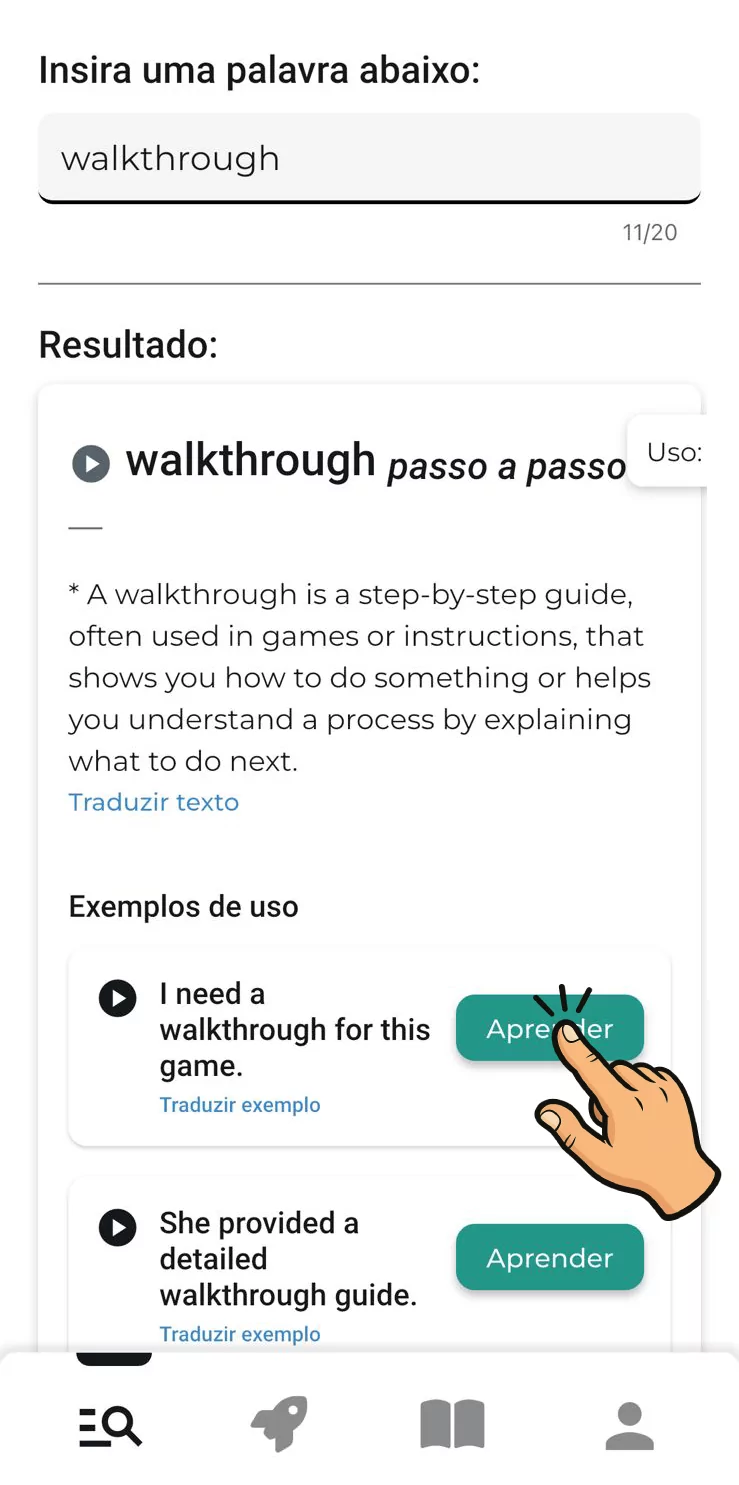
Start with one of the sentences you wrote down, not a list of useful words. Type the word that tripped you up (a single word, an expression or a phrasal verb like fall through): the result shows the meaning and at least five example sentences, with audio.
Closer to the beginning and nothing jotted down yet? Open one of the Stories: short texts of 30 sentences to build your vocabulary.
Every day
Tap Aprender (Learn) on the sentences you can picture hearing on a show or saying at work. Fewer, better ones: what counts is what you'll review, not how long your list is.
Spotted a pronunciation or translation error in a sentence? Report it in the app: the sentences are AI-generated, and reported ones go to human review.
Every day
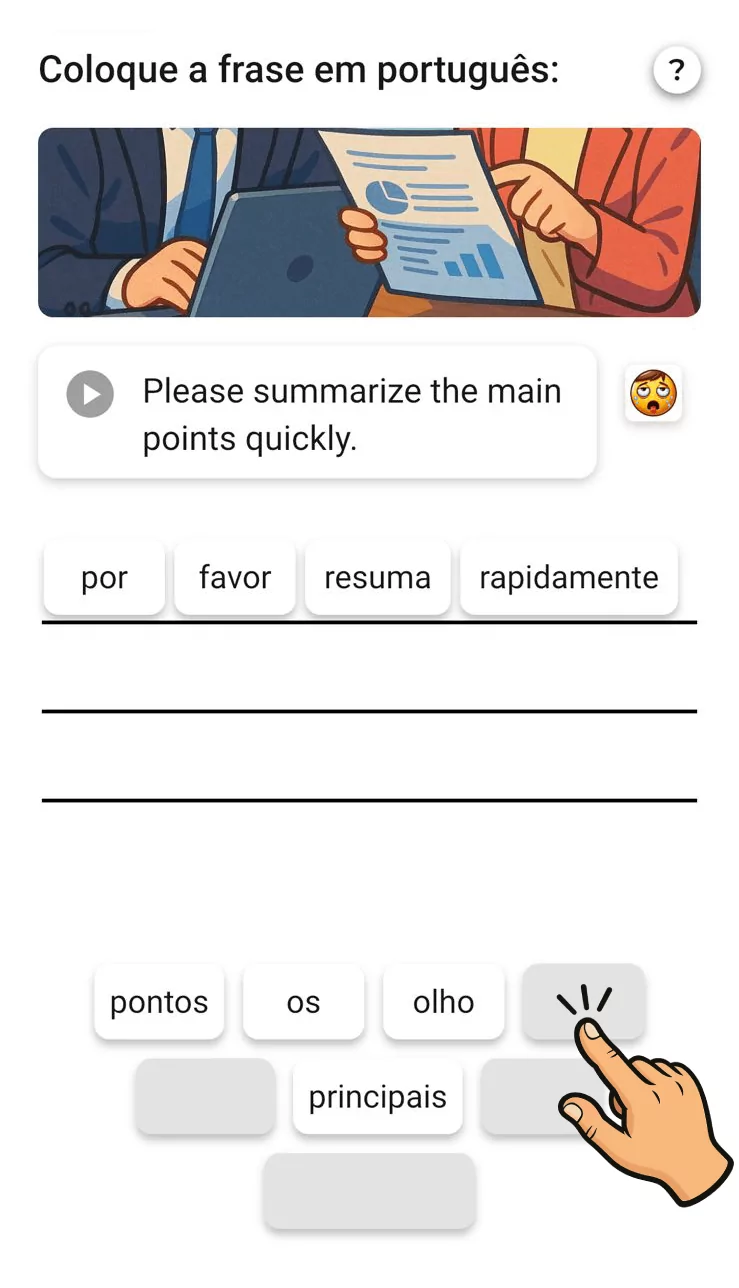
Each session has 10 sentences, practiced by speaking, seeing and listening. Try to recall each one before you check the answer. Getting it wrong is part of it: a miss is what brings the sentence back sooner. Done and there are still sentences to study? You can go straight into another session.
In speaking mode, the app shows what it heard and, if it doesn't match, gives you a pronunciation tip spelled the way a Brazilian would read it: “I should have known better.” becomes “ai xúdav nôun bérer”.
Every day
From here on, the app decides when each sentence comes back, on a ladder of intervals of 1, 1, 3, 5, 7, 14, 28 and 54 days: get it right and it climbs a rung and returns later; miss it and it drops a rung and returns sooner. Review what came back first, then look up the day's new sentences.
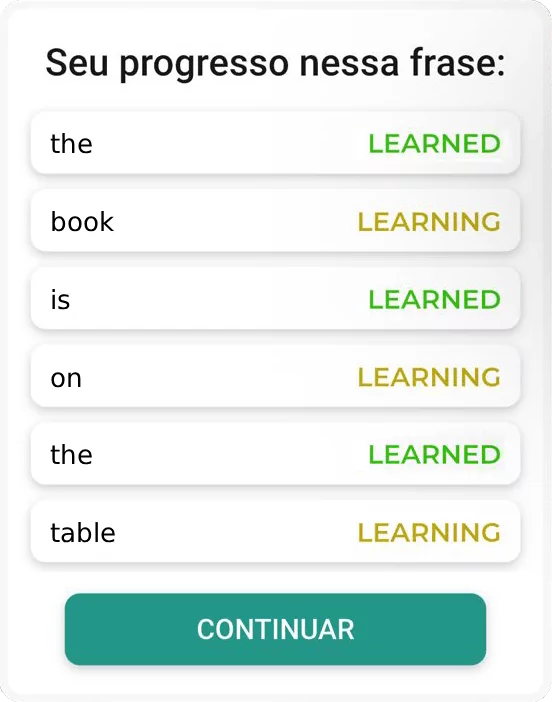
The app scores every word: your correct answers divided by the times it came up. Once every word in a sentence is learned, the sentence leaves active practice and the next ones move up.
In your routine
Studying starts before the session: the moment you half understand a sentence and write it down. Here's an example day:
During the day
In a meeting, an episode, an email: whenever a line only sort of lands, write down the whole sentence, not just the word.
At your set time
In 20 minutes, an order that works:
Drive to work? Save the session for another time.
In the evening
On your show, a sentence you reviewed last week comes up and you get it instantly, without pausing. That's how you measure progress: by what you recognize outside the app.
The 20-minute split comes from our post How to study vocabulary in 20 minutes a day.
Consistency
By accepting that the beginning is the hardest part and that missing a day doesn't undo what you've built. Four rules backed by research, and one about what the app does to help.
Write yours
When …, I open dailyBe and do my review.
Ways to fill in the blank:
Tie the session to something that already happens in your day. Psychologists call this an implementation intention: a simple technique with plenty of research behind it.
Gollwitzer and Sheeran (2006): 94 tests, medium-to-large effect
In a study of 96 volunteers, the time it took for a new habit to become automatic ranged from 18 to 254 days. A hard start doesn't mean the method isn't for you.
Lally et al. (2010)
No double session to make up for it, no starting over. In the same study, missing a single opportunity didn't hurt habit formation. The risk is letting one day turn into a week.
Lally et al. (2010)
Trying to recall feels harder than rereading, so it feels like less progress. People who just reread a text felt more confident and, a week later, remembered less.
Roediger and Karpicke (2006): 61% vs. 40%
Set a daily goal in the app that fits your day: 10, 15 minutes or more. Every day you hit it earns a star, your streak shows how consistent you've been, and you can add friends and compare study time over the week and the month.
In the app: daily goal, streak, stars and friends
The sign
dailyBe clicks the day it becomes routine: you run into a strange word, look it up, add it, review it a few times and realize it's starting to stick.
Measure that, not your minutes in the app: how many sentences from your list did you recognize on a show or in a conversation this week?
Questions
There's no magic number. Start small: the three sentences you jotted down that day are a good starting point. Since every sentence you add comes back for review, adding too many today means too many reviews in the days ahead.
It depends on your level. In the tests we watched, people with more English got through a 10-sentence session in 4 to 5 minutes; people just past the start took close to 25. That's why we recommend a daily amount instead: 20 to 30 focused minutes, over as many sessions as that takes.
Yes: each session has 10 sentences, so you can do one in the morning and another at night. You only lose some of the benefit when the moments are scattered and distracted, because every restart costs you some focus. Two focused blocks beat four squeezed between other things.
Yes. Classes give you structure and conversation; dailyBe covers the vocabulary that's yours alone. Words that came up in class and didn't stick are great candidates for your first search.
Nobody can promise you a timeline, and you should be wary of anyone who does. A good sign is when sentences you've reviewed start showing up on your shows and you catch them instantly. Count how often that happens each week.
iOS and Android
You already have the raw material: the sentence you half understood this week.